Artificial Skylight Comparison: Innerscene Virtual Sun vs LED Sky Panels
LED panel
Appearance of flat 2D image
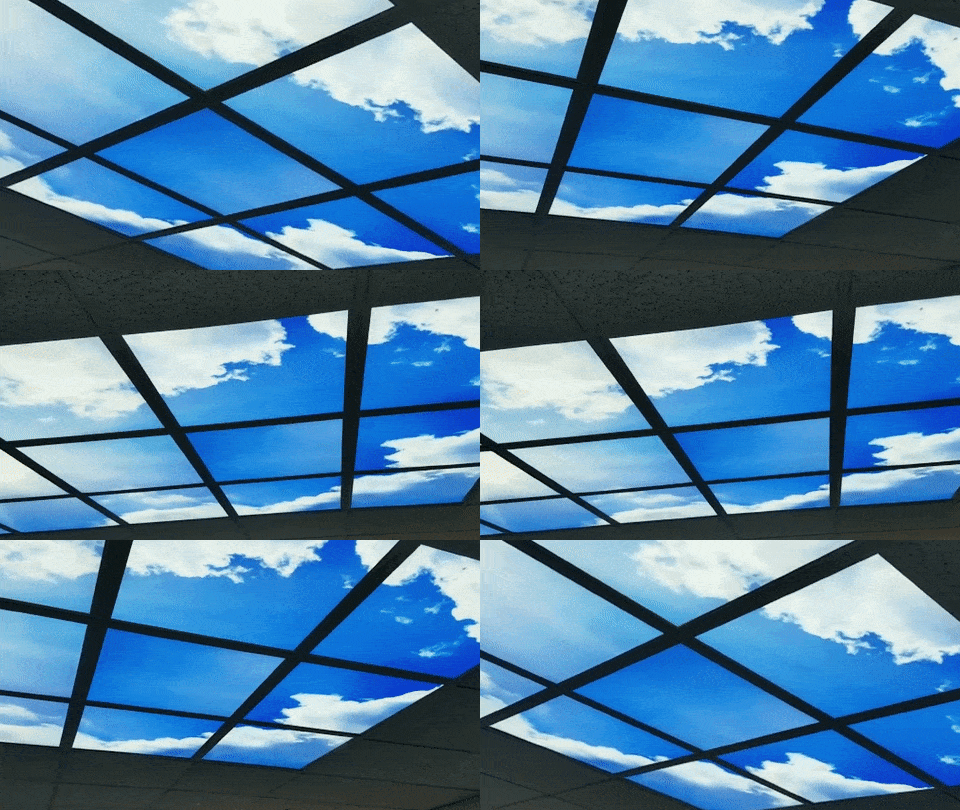
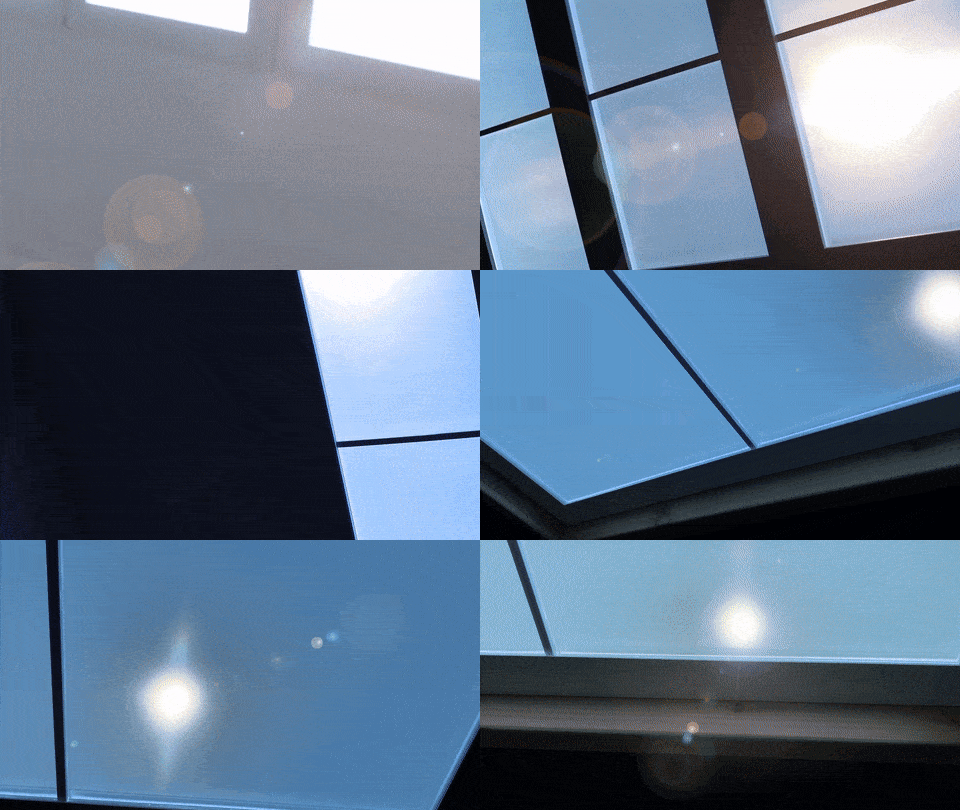
Virtual Sun
Appearance of infinite depth
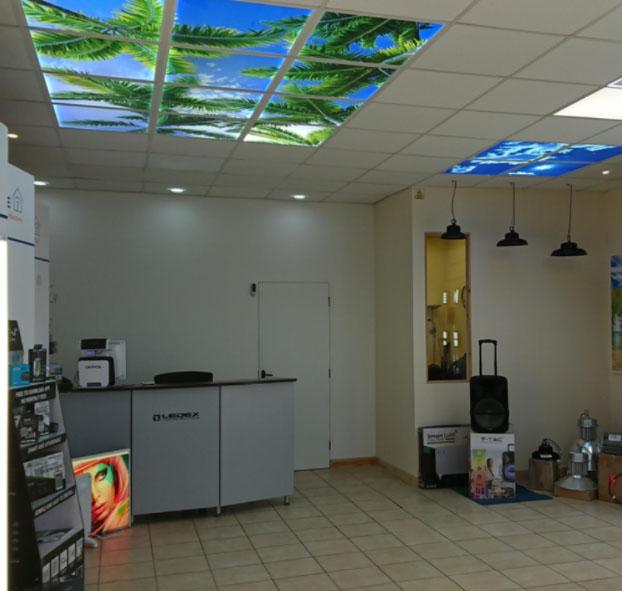
LED panel
Unnatural room illumination
Virtual Sun
Appearance of natural illumination

Comparison table
This page compares Virtual Sun to flat image-panel skylights (LED light box + printed/photographic/LCD image layer). Manufacturers may offer multiple product lines; features can vary by model.
Slide left on table | ||
Traditional LED panel | Innerscene | |
|---|---|---|
| No, sun & sky appears as flat back-lit image that shifts with head movement | Yes — Virtual Sun: sun tracks head movement at optical infinity; Circadian Sky: featureless surface with reflective depth cues | |
| No, left and right eyes perceive a flat image on the ceiling | Yes | |
| No, our eye muscles involved in focus contract and use near-vision | Yes, our eye muscles involved in focus relax and use far-vision | |
| No, emits only 180° diffuse light | Yes, emits 2.5° sunbeam and 180 degree sky light | |
| No | Yes | |
| Typically no | Yes | |
| No, unable to see true colors of objects leading to unnatural appearance of room | Yes | |
Ability to dim/brighten? | Sometimes | Yes |
| Typically single CCT (e.g. 6,500K); some 2-chip tunable models reach ~6,500K max | Circadian Sky: 2,200K – 200,000K; Virtual Sun: 3,200K – 200,000K | |
| No — emitted light is max ~6,500K (cool white); image may depict blue sky but room illumination is not sky-colored | Yes — Circadian Sky up to 200,000K; Virtual Sun up to 200,000K (deep blue zenith sky) | |
| Can drift outside ANSI tolerances (±0.006 Duv) at intermediate CCTs, producing visible tint shift | ≤0.004 across full CCT range, typically ≤0.003 (tighter than common ANSI chromaticity bins) | |
| 3–7 steps (visible color variation between fixtures) | 1-step SDCM, individually factory calibrated | |
| Typically not specified | 84–98 across full CCT range | |
| Most intermediate CCTs fall outside ANSI-defined white regions | Yes — all CCTs within ANSI standard (2,200K–6,500K); above 6,500K characterized by chromaticity, Duv, and TM-30 metrics | |
| Not specified / limited range | Circadian Sky: 0.4 – 1.6; Virtual Sun: 0.5 – 2.1 | |
| No — LED binning only | Yes — sensor-calibrated mixing tables per fixture | |
| Typically no | Yes — automated CCT and intensity changes throughout the day | |
| No | Yes — window-mounted sensor streams live outdoor sky color to fixtures wirelessly | |
| No | Yes — ensures identical color and dimming across a group, even when driven by analog controls (e.g. 0–10V) | |
| Varies | Yes — 40kHz PWM | |
¹ ANSI C78.377 defines chromaticity quadrilaterals for nominal CCTs from 2,200K to 6,500K. Above 6,500K no ANSI-defined white regions exist; Innerscene characterizes output using measured chromaticity (x,y / u',v'), Duv, and TM-30 metrics. Very high CCT values are reported as equivalent correlated color temperature derived from chromaticity.
About traditional LED image panels
A number of companies offer artificial skylight that use a simple technology based on LED backlighting and a printed or image-bearing panel as shown above.
This type of product goes by various different names, including:
- LED Sky Panel / LED Light Windows / LED Glass Windows
- LED Sky Ceiling
- Fake Window / Artificial Window / Virtual Window
- Fake Skylight / Artificial Skylight / Virtual Skylight
- Electric Skylight
- LED Glass Window / LED Panel Window
- Sky Roof Light / Box Skylight
Traditional sky LED panels combine a backlit light source with a printed or image-bearing panel to produce a backlit 2D image appearance similar to other backlit graphic panel systems.
While such products can look visually correct in a photograph limited to a single camera viewpoint, they do not provide a believable sky view in real life for reasons discussed below. Because the image being back-lit is 2 dimensional in nature, in real life our two eyes quickly perceive it for what it is - a flat backlit image on your ceiling. In more advanced versions of LED panel products, a LCD screen is used to allow for dynamic images - however this suffers the same problems of looking flat and having poor light quality.
A few of the reasons these panels do not fool our brains into thinking we are looking outdoors into the real sky are listed below.
Depth perception cues & the appearance of a real window
Motion parallax cue
When we move our head left to right and forward and backward, objects that are located at infinity appear to move with us. Objects that are close to us will move in the opposite direction of our head. With the smallest of head movements, a casual observer would perceive an LED panel as a flat image located on the ceiling because printed or image-bearing features shift relative to the viewer, revealing that the surface is nearby.
Virtual Sun provides perfect motion parallax cues — when you look at the sun and move your head, the sun will perfectly track your head movements as if it was a million miles away.
Circadian Sky satisfies the motion parallax requirement differently: its surface is evenly lit with no distinguishing features, so there are no fixed image elements that shift as you move. Additionally, its dual reflective glass creates reflections of objects and light that appear to originate behind the panel, reinforcing the perception of depth rather than a flat nearby surface.
In the animation belowon the right, note that objects closer to the camera appear to move faster than objects in the background. Because the sun is millions of miles away, it stays fixed in the sky and appears to travel with us.

Stereopsis cue

Our brains process images received from the left and right eye to estimate depth. Objects that are far away from us will be seen as the same image by both the left and right eye, objects that are close to us will have differences that allows the brain to calculate the distance between us and the object. You can try this by closing one eye at a time and seeing how near and far objects appear. When LED panel manufacturers advertise their products online, they are only presenting a single motion-less camera view of the product, so the lack of 3D isn’t as apparent. When LED panel manufacturers show the panels in videos, they typically use only tilt & zoom where the problem of Motion Parallax Cue can be hidden from you. In contrast, Virtual Sun presents the same image of the sun and sky to your left & right eye making it appear as if the sun & sky are millions of miles away.
Our left and right eyes see fairly different images as shown below. Our brain processes the differences between these images to determine how far objects are from us. When there are great differences for a point, it is perceived to be close to us. As an object approaches infinity, the left and right eyes will see exactly the same thing and our brain signals to us that the object is very far away. Virtual Sun shows an image of the sun that is the same to our left and right eyes using a unique new technology patented by Innerscene.
Accommodation cue
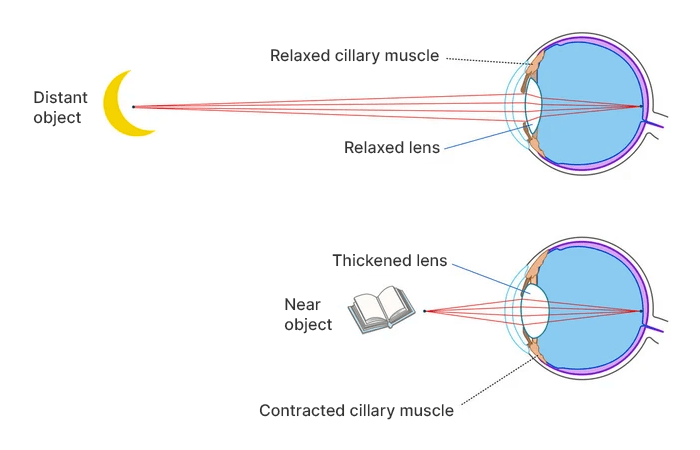
Your brain controls muscles in your eye to change the focus when looking at close objects (<2m) and far objects. When looking at a Traditional LED panel from a distance of less than 2m (which is typical), our brain will adjust our eye focus to accommodate a nearby object which instantly tells us the object is not far away from us. In contrast, Virtual Sun is actually presenting the sun and sky at optical infinity so our brain will focus our eyes far away when looking “through” the fixture. Your mobile phone camera does the same thing. When taking a picture of the Virtual Sun, your camera will change it’s focus to accommodate distant objects no matter how close you are to a Virtual Sun unit.
For more depth cues that are used by your brain to determine how far away an object is from you, see:
http://www.hitl.washington.edu/projects/knowledge_base/virtual-worlds/EVE/III.A.1.c.DepthCues.html
How the eye focuses light
CRI (Color Rendering Index)
CRI < 80: Poor
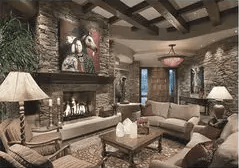
CRI 80-84: Good
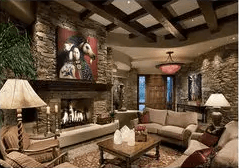
CRI 85-90: Very Good
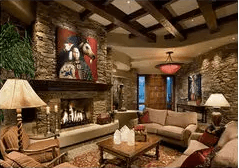
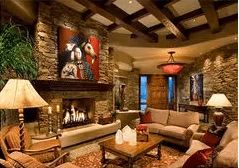
CRI 91-100: Excellent
Overcoming the limitations of traditional artificial skylight LED panels
Our brains process images received from the left and right eye to estimate depth. Objects that are far away from us will be seen as the same image by both the left and right eye, objects that are close to us will have differences that allows the brain to calculate the distance between us and the object. You can try this by closing one eye at a time and seeing how near and far objects appear. When LED panel manufacturers advertise their products online, they are only presenting a single motion-less camera view of the product, so the lack of 3D isn’t as apparent. When LED panel manufacturers show the panels in videos, they typically use only tilt & zoom where the problem of Motion Parallax Cue can be hidden from you. In contrast, Virtual Sun presents the same image of the sun and sky to your left & right eye making it appear as if the sun & sky are millions of miles away.
Our left and right eyes see fairly different images as shown below. Our brain processes the differences between these images to determine how far objects are from us. When there are great differences for a point, it is perceived to be close to us. As an object approaches infinity, the left and right eyes will see exactly the same thing and our brain signals to us that the object is very far away. Virtual Sun shows an image of the sun that is the same to our left and right eyes using a unique new technology patented by Innerscene.
Dynamic CCT
Traditional LED panels can typically only emit one CCT, 6500K being the most common. However, there are many reasons why a color tunable product is preferred:
Light from the real sky changes constantly throughout the day. Virtual Sun’s Circadian Rhythm mode does exactly this. Rooms with static CCTs can feel monotonous and claustrophobic because there is no change all day long.
Research suggests that Circadian Rhythm Lighting can contribute to:
- Faster cognitive processing
- Increased alertness in the morning
- Improved mood, productivity, and concentration
- Improved sleep
- Reduced hyperactivity
- Reduction in errors and accidents
Effects vary by population, lighting design, and study conditions. Consult project-specific research and design guidance.
Most backlit panels provide single channel output, some offer two channel LED mixing. Two-channel mixing can drift above or below the blackbody locus (pink/green tint shift) and may fall outside ANSI-defined white chromaticity regions at intermediate settings. For color-critical applications, ask for chromaticity coordinates (x,y or u',v') and Duv across the full tuning range and confirm the output remains within ANSI C78.377 'white' regions.
For more information on this topic, see this article.
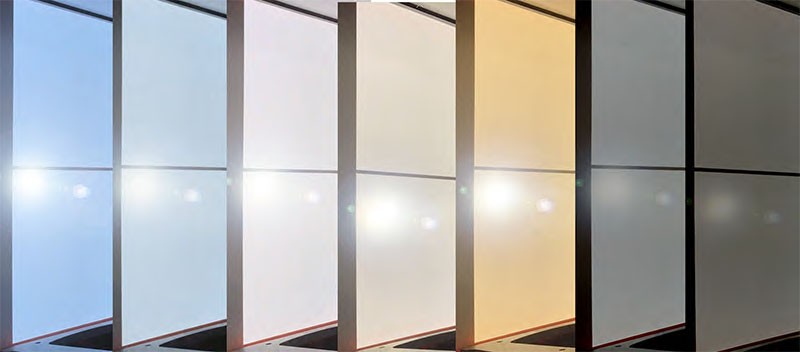
The image below shows the appearance of Virtual Sun at a few different times of day and night. The changes occur slowly over the course of a 24 hour period.
Light distribution
LED and LCD panels only produce diffuse light which sends light in all directions, but do not have any directional “collimated” light. A room light by natural light will typically have both components at various times of the day. Virtual Sun can be thought of as 2 light fixtures in 1; there is a diffuse sky component that emits light in a 180 degree beam similar to traditional LED panels, but what makes it special is the sunbeam which emits a 2.5 degree angle beam that will light up your floor or wall to further create the illusion of real sunlight coming into a room.
Light Quality Deep Dive
The following sections explain the light quality metrics from the comparison table above. Click any linked term to view detailed technical documentation.
CCT Range & True Blue Sky Color
Traditional LED panels are typically fixed at a single color temperature (commonly 6,500K), while some two-channel tunable white models can blend between a warm and cool LED to reach approximately 6,500K. However, clear blue sky can range from 8,000K to well above 20,000K depending on conditions. Innerscene's 4+ chip ATMOS Platform in Circadian Sky achieves a 2,200K to 200,000K range, while Virtual Sun extends from 3,200K all the way to 200,000K — reproducing everything from warm interior light to deep blue zenith sky. Two-chip systems cannot produce true sky color at any point in this range. The extended CCT capability is also essential for maximizing melanopic content during daytime hours.
Duv — Color Accuracy on the Blackbody Curve
Duv measures how far a light source's color deviates from the natural blackbody curve. Deviations create visible pink or green tints that make light appear unnatural. Two-channel tunable-white systems can drift above or below the blackbody locus and may fall outside common ANSI chromaticity tolerances (e.g. ±0.006 Duv) at intermediate settings unless specifically designed and calibrated to stay within them. Circadian Sky maintains Duv ≤0.004 across the full CCT range (typically ≤0.003) — a tighter tolerance than common ANSI chromaticity bins and consistent with Energy Star chromaticity requirements.
MacAdam Ellipse — Fixture-to-Fixture Color Consistency
A MacAdam Ellipse step (also called SDCM) measures how much color can vary between two light sources before the difference becomes visible. Standard LED products are typically binned to 3–7 MacAdam steps, meaning fixtures side-by-side may show noticeably different colors. Each Circadian Sky fixture is individually factory-calibrated using precision photometric sensors, achieving 1 MacAdam step (SDCM) — a level of consistency that approaches the limits of human color perception.
CRI, R9 & TM-30 — Color Rendering Quality
CRI (Color Rendering Index) measures how faithfully a light source reveals the true colors of objects. Traditional LED panels that rely on backlit image layers can significantly reduce the CRI of the emitted light. R9, which measures deep red rendering, is particularly important for skin tones, healthcare, and retail environments. Circadian Sky achieves CRI 91–98 and R9 84–98 across its full CCT range. Its published CRI, R9, and TM-30 performance aligns with common color-quality thresholds used in programs such as WELL v2 (L08) and DLC Premium pathways. Project compliance depends on the specific credit pursued and project design; verify requirements with the program documentation.
ANSI C78.377 — Valid Color Temperature Standards
ANSI C78.377 defines specific chromaticity regions (quadrilaterals) for nominal CCTs from 2,200K to 6,500K. To claim compliance with ANSI C78.377 nominal CCT categories, the measured chromaticity should fall within the ANSI-defined tolerance region for that nominal CCT. When two-channel tunable white systems mix between their warm and cool LEDs, the resulting colors at intermediate settings can fall outside these standardized regions — meaning the light produced may not match what we expect that color temperature to look like. Innerscene's multi-chip architecture produces all CCTs within ANSI-defined white regions across the 2,200K–6,500K range. Above 6,500K (where ANSI C78.377 nominal “white” bins end), Innerscene fixtures target daylight/sky chromaticities and characterize output using measured chromaticity (x,y / u′,v′), Duv, and TM-30 metrics.
Melanopic Ratio — Circadian Health Impact
Melanopic ratios measure how effectively a light source stimulates the eye's melanopsin-containing cells that regulate our circadian rhythm. Higher melanopic content supports alertness, mood, and sleep quality. Traditional LED panels with limited CCT range offer limited melanopic benefit. Circadian Sky achieves melanopic ratios of 0.4 to 1.9, while Virtual Sun reaches 0.5 to 2.1 — both industry leading. These high ratios make it possible to meet WELL v2 melanopic EDI targets at lower lux levels, reducing glare and energy consumption while improving occupant well-being.
Individual Factory Calibration
Standard LED fixtures rely solely on LED binning — sorting chips by color before assembly — to control color consistency. This approach has inherent limitations, especially for tunable systems where chips are mixed at varying ratios. Innerscene's ATMOS Platform uses precision photometric sensors during factory calibration to create individual color mixing tables for each fixture. This per-fixture calibration is what enables the 1-step MacAdam (SDCM) consistency and ≤0.004 Duv accuracy across the full CCT range.
Circadian Rhythm Scheduling
Traditional LED panels provide static illumination that does not change throughout the day. Circadian Sky includes built-in automated scheduling that adjusts color temperature and intensity to follow natural daylight patterns. This supports occupant circadian rhythms without requiring manual intervention. Scheduling can be configured via multiple control protocols including 0–10V, DMX, DALI, and Casambi.
Real Sky Color Tracking (SkySync)
For environments that want indoor lighting to reflect actual outdoor conditions, Innerscene's SkySync is a window-mounted dual-sensor device that continuously measures real sky color and streams it wirelessly to Circadian Sky and Virtual Sun fixtures. Indoor lighting tracks outdoor sky in real time — when the sky shifts from warm sunrise to cool midday blue, the fixtures follow automatically. SkySync requires no wiring, mounts to the inside of any window, and has a 10+ year battery life. It can communicate directly with fixtures or extend its range via the Innerscene Mini Hub over LAN or cloud. Traditional LED panels offer no equivalent capability.
Wireless Fixture-to-Fixture Sync
When multiple fixtures are installed in a group, even small differences in color or brightness are noticeable. Analog control signals like 0–10V are inherently imprecise — cable resistance, connector losses, and DAC tolerances mean each fixture may receive a slightly different signal. Innerscene fixtures include built-in wireless sync that coordinates color and dimming digitally across every fixture in a zone. This ensures perfectly matched output regardless of the upstream control method, whether 0–10V, DMX, DALI, or Casambi. Traditional LED panels controlled via analog signals have no mechanism to guarantee matched output across a group.
Flicker-Free Dimming
LED flicker can cause eye strain, headaches, and may trigger photosensitive conditions. It is also visible in video recordings and can interfere with medical imaging equipment. Many LED panels use low-frequency PWM dimming that produces perceptible flicker, especially at lower brightness levels. Circadian Sky uses 40kHz PWM dimming — well above the threshold of both human perception and camera detection — ensuring flicker-free operation at all brightness levels down to less than 1% output.
Illuminating Wellness
Discover the Impact: Celebrating Exceptional Lighting Transformations
Office
Apple Campus - Cupertino
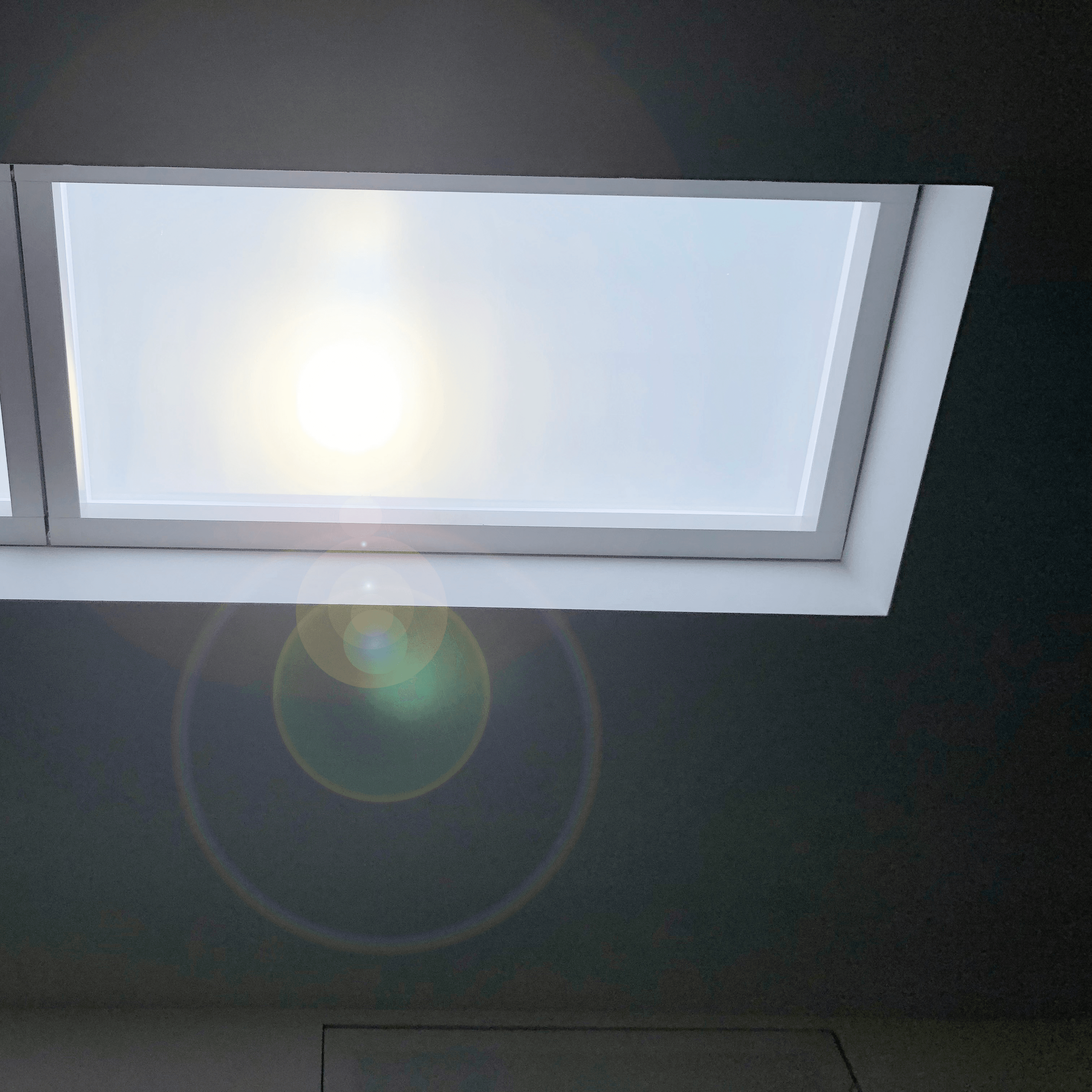
Boosting well-being and productivity at Apple Campus with Innerscene’s lighting.
Commercial
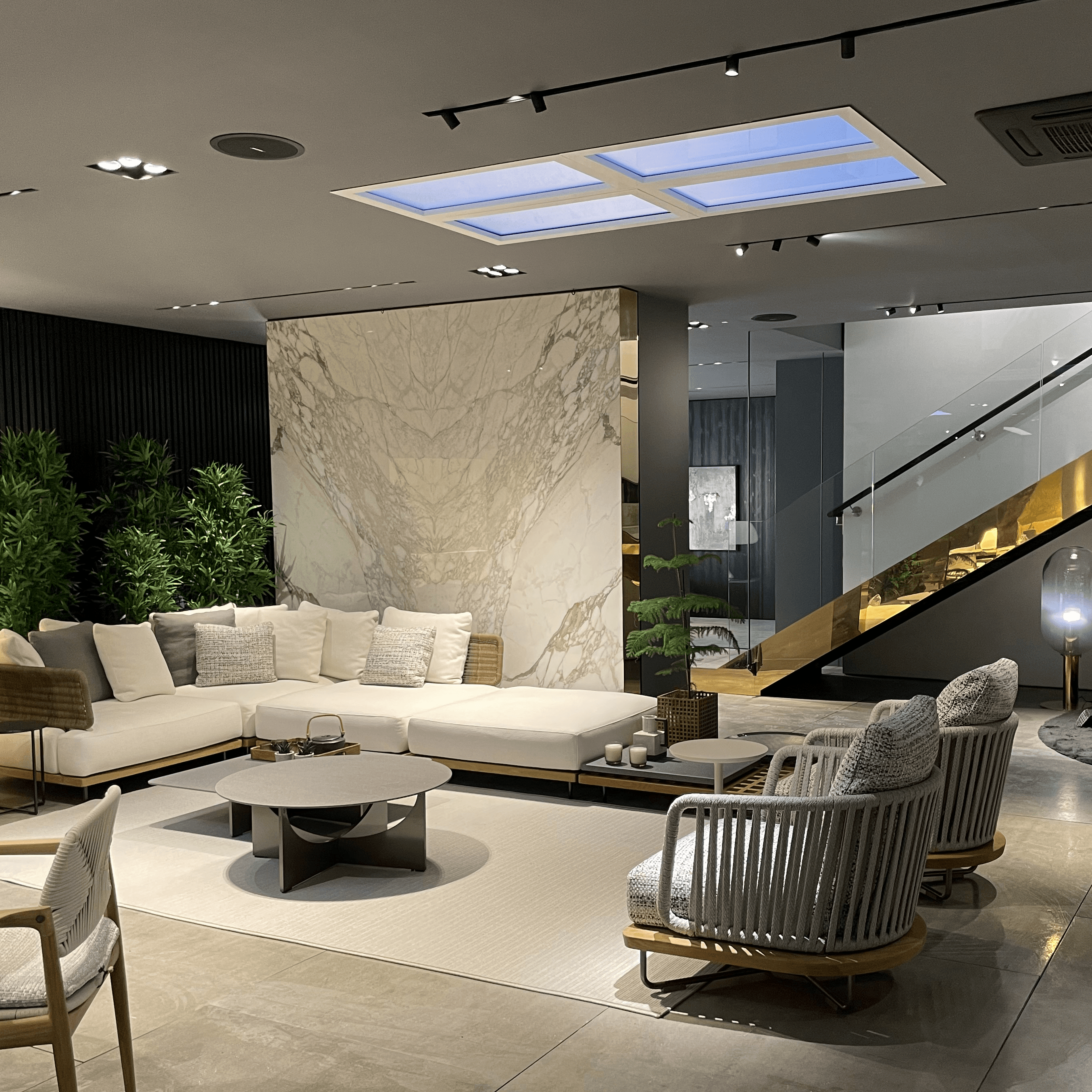
Minotti Showroom - London
Minotti London’s display, lit by Innerscene’s Virtual Sun, melds Italian luxury with the brilliance of daylighting.
Healthcare
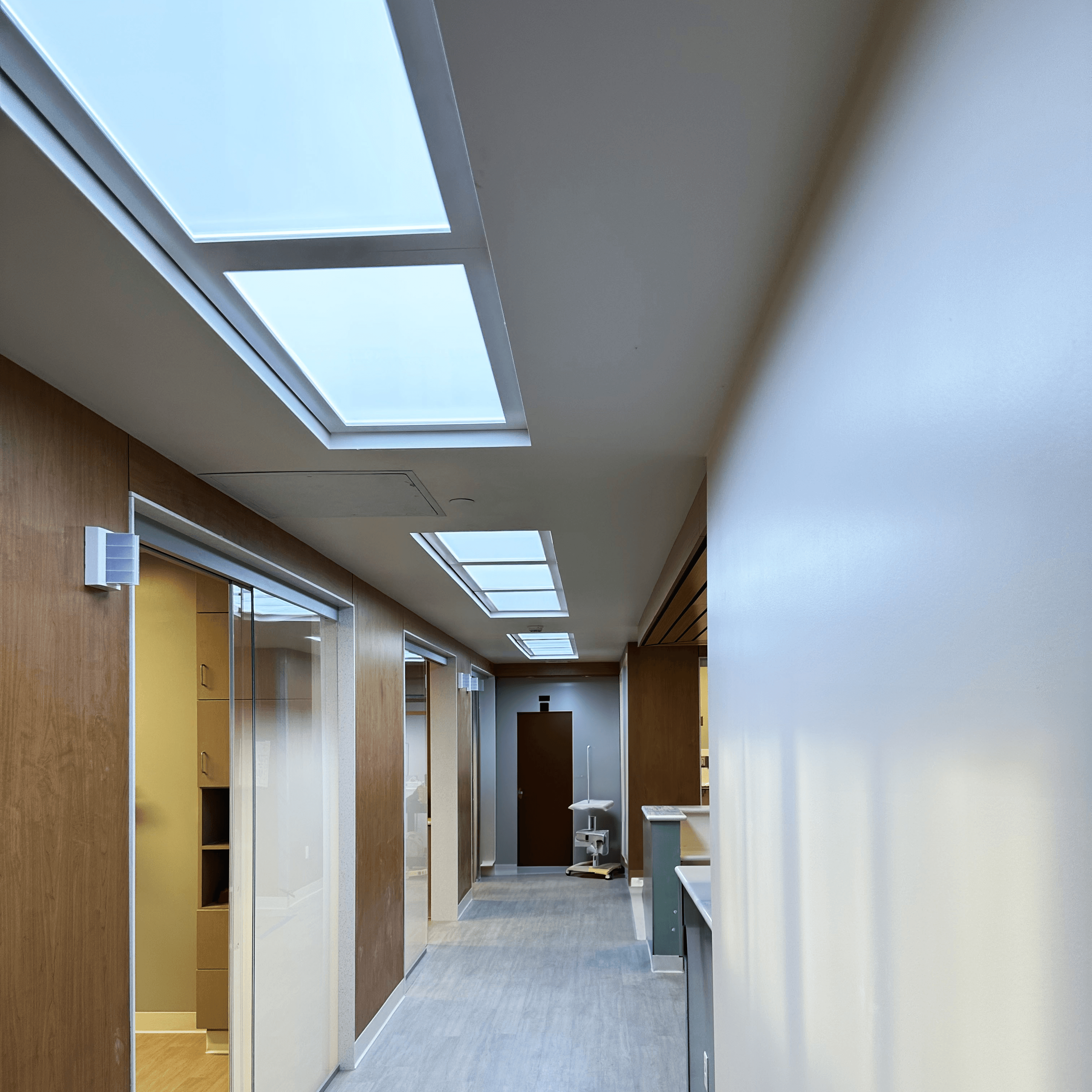
Cancer Center - Monterey
Monterey Comprehensive Cancer Center’s hallways glow with the soft, nurturing light of Virtual Sun units.