Melanopic Light in Long-Term Care: How Circadian Lighting Supports Elderly Residents
1. Executive Summary
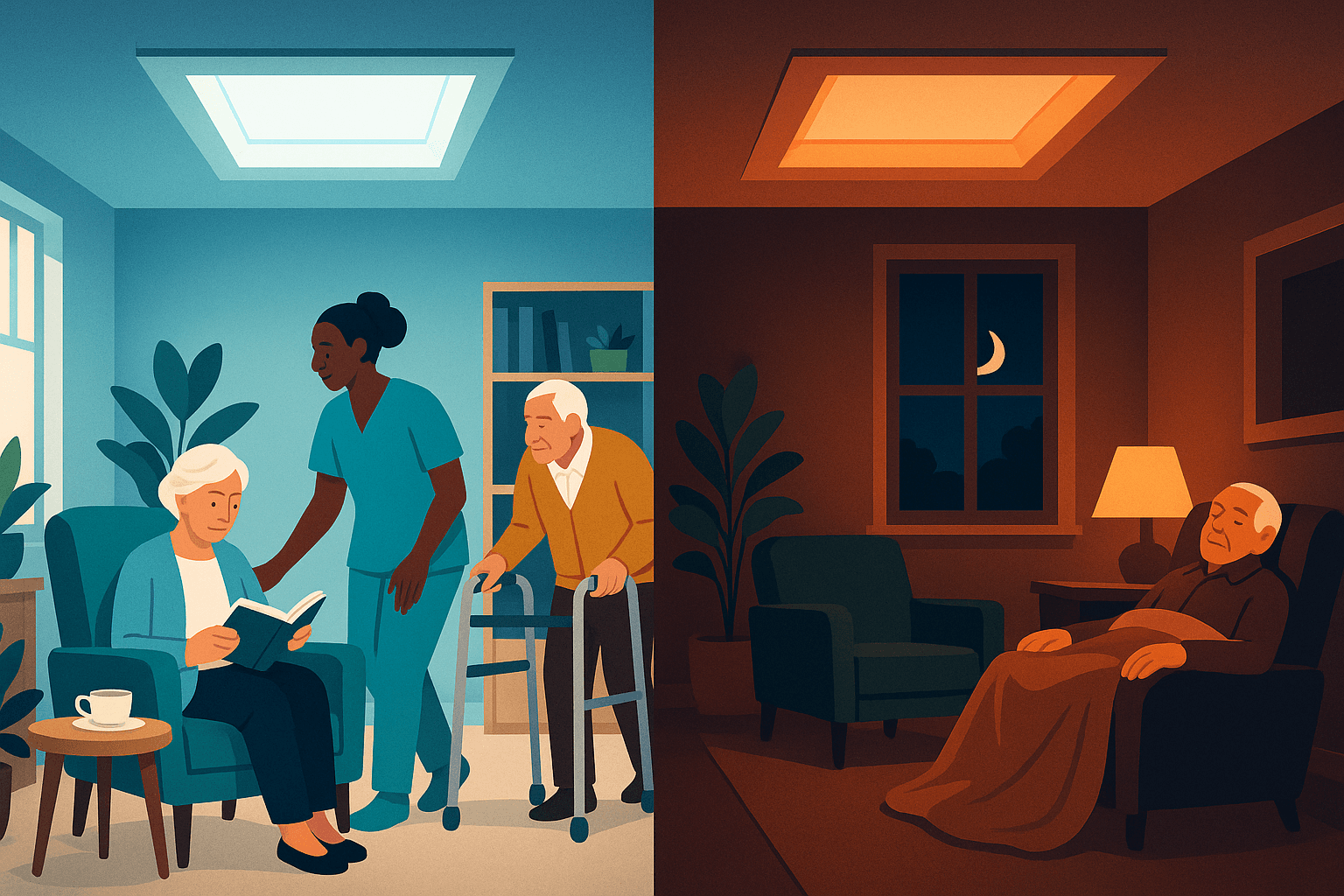
Residents of long-term care (LTC) facilities face a perfect storm of circadian disruption: insufficient daylight exposure, age-related reductions in light sensitivity, and high rates of dementia-related sleep disorders. Melanopic light — the specific spectrum sensed by intrinsically photosensitive retinal ganglion cells (ipRGCs) — is the primary driver of circadian rhythm regulation.[1] Emerging clinical evidence shows that properly timed, melanopically-enriched light exposure can improve sleep quality, reduce agitation and delirium, and enhance quality of life for elderly care home residents.[2] The Innerscene Circadian Sky is uniquely positioned to address these needs with its industry-leading 2,200K–200,000K CCT range, verified melanopic ratios, and automated solar-clock scheduling.[3]
2. The Problem: Circadian Disruption in Long-Term Care
2.1 Inadequate Light Environments
Indoor lighting levels in nursing homes are consistently reported as too low, which may contribute to the high prevalence of sleep disturbances among residents compared to elderly individuals living at home.[4] The light environment in care homes directly impacts resident rest-activity rhythms — and the prevalence of sleep problems in elderly care home residents may be explained by age-related changes in the circadian timing system combined with inadequate light exposure.[5]
2.2 The Aging Eye: A Critical Challenge
One of the most important considerations for LTC lighting is that older adults require significantly higher light intensities than younger people for equivalent circadian effects.[2] Age-related changes in the eye — including lens yellowing and reduced pupil size — dramatically reduce melanopic light sensitivity. Seniors may need up to 5× more blue-enriched light to achieve the same circadian benefit as a younger person.[6]
Research on the aging crystalline lens confirms that its increasing optical density with age selectively filters short-wavelength (blue) light, reducing the melanopic stimulus reaching the retina.[7] The maximal sensitivity of ipRGCs is in the blue-light range — making this age-related filtering particularly problematic for circadian health.[8]
2.3 Dementia, Sleep Disruption, and Sundowning
Sleep-wake behaviour disruption is pervasive in community dementia care, with light exposure being a key modifiable factor.[9] Dynamic light exposure has been shown to impact sleep-wake patterns and behavioral and psychological symptoms of dementia (BPSD) in people with dementia.[10] Dawn and dusk simulation has been explored specifically to improve sleep patterns and daily functioning of nursing home residents with dementia.[11]
3. Clinical Evidence: Melanopic Light Therapy for the Elderly
3.1 Delirium Reduction in Elderly Patients with Dementia
Zou et al. (2022) conducted a randomized controlled trial examining light therapy in older adults with Alzheimer's disease-related dementia. After a 4-week regimen of daily bright light exposure, they observed a significant reduction in delirium symptoms compared to controls. Confusion Assessment Method (CAM) scores improved after 2 weeks of light therapy and further improved by 4 weeks, indicating fewer and less severe delirium episodes.[2]
3.2 Bright Light Therapy Outcomes in Nursing Homes
Research on bright light therapy in nursing home patients with dementia has investigated its effects on pain perception and non-visual photoreception through ipRGC stimulation.[12] The biodynamic lighting approach — using melanopic measurements — has shown promising results across multiple senior citizen facilities, with opportunities for improved well-being and circadian entrainment.[13]
3.3 Multicomponent Delirium Prevention
Hospitals implementing multicomponent delirium prevention programs that include a lighting component have reported significantly lower rates of postoperative delirium, better preservation of cognitive and physical function, and even shorter hospital stays compared to controls. Scheduled bright light exposure during daytime was considered a key element of these protocols.[2]
3.4 Key Clinical Takeaways
- Natural light matters: Rooms with windows show consistently lower delirium rates[2]
- Bundle approach works best: Light interventions are most effective when combined with other circadian-supporting measures[2]
- Timing is critical: Bright blue-enriched light during day, minimal blue light at night[2]
- Vulnerable populations: Elderly and dementia patients show particular benefit from structured light exposure[2]
4. Industry Standards for LTC Lighting
| Standard / Guideline | Requirement |
|---|---|
| WELL Building Standard v2 | ≥ 250 melanopic lx in work areas by day; ≤ 50 lx at night; ≥ 250 melanopic lx in 24-hour facility break rooms[6] |
| IES RP-29-22 | Recommends tunable, high-CRI fixtures that can deliver bright, blue-rich light for staff work areas and low-circadian-impact light for patient rooms[6] |
| Healthcare CRI | CRI ≥ 90, R9 ≥ 75; patient rooms: dimmable, adjustable CCT 2700K–6500K+ for circadian support[14] |
| Am. Academy of Sleep Medicine | Endorses timed bright-light therapy as evidence-based treatment for circadian disorders[6] |
5. Why Innerscene Circadian Sky Is Uniquely Suited for LTC
5.1 Unprecedented Spectral Range
The Circadian Sky offers a tunable CCT range of 2,200K to 200,000K — far exceeding standard tunable-white fixtures (typically limited to 2,700K–6,500K).[15] This is critical for elderly populations who need higher melanopic content. At higher CCTs, the Circadian Sky achieves melanopic ratios well above 1.0 — meaning each lux of light carries more melanopic stimulus than standard daylight.[16]
5.2 Verified Melanopic Performance
The Circadian Sky's melanopic ratios across its full CCT range are factory-verified[3]:
| CCT (K) | Melanopic Ratio | Typical Application |
|---|---|---|
| 2,200K | 0.403 | Evening / nighttime — minimal circadian impact |
| 3,000K | ~0.63 | Warm ambient — traditional evening lighting |
| 5,000K | 0.887 | Daylight — moderate circadian stimulus |
| 6,500K | 1.046 | Cool daylight — strong circadian stimulus |
| 9,600K | 1.228 | Blue-enriched — high melanopic for elderly |
| 14,600K | 1.368 | Deep blue sky — very high melanopic for compromised vision |
| 200,000K | 1.533 | Maximum melanopic output — compensating for severe lens yellowing |
Source: Circadian Sky SPD data[16]
This range means the Circadian Sky can deliver the 5× higher melanopic stimulus that elderly residents need — something impossible with conventional tunable-white fixtures limited to 6,500K.[6]
5.3 Superior Color Rendering for Clinical Environments
The Circadian Sky maintains CRI 92–98 and R9 84–98 across its entire CCT range, with 1-step MacAdam ellipse color consistency.[15] This meets or exceeds healthcare lighting requirements where accurate color rendering is essential for patient skin tone assessment and clinical diagnosis.[14]
5.4 Automated Circadian Scheduling
Each Circadian Sky fixture includes built-in geolocation and clock with automated Circadian Cycle scheduling.[15] The system can run a solar-clock based cycle (P0002) that automatically adjusts spectrum and intensity throughout the day to mirror the sun's natural pattern — delivering high-melanopic blue-enriched light in the morning, transitioning through daylight, and dimming to warm, low-melanopic light in the evening.[15]
This automation is essential in LTC settings where staff cannot be expected to manually adjust lighting throughout the day. The system delivers the correct melanopic dose at the right time, every day, without intervention.
5.5 Behavioral Health Variant
Innerscene offers a purpose-built Behavioral Health (BH) trim option specifically designed for institutional and patient care environments[15]:
- Anti-ligature design — no exposed edges or points
- Tamper-resistant Torx security screws — countersunk and white to match trim
- High-impact resistant polycarbonate lens — withstands abuse
- IC-rated recessed housing with easy conduit/Romex entry
- TÜV certified, adheres to UL 1598 standards
5.6 Meeting WELL & Healthcare Standards
The Circadian Sky meets WELL v2 Feature 8 flicker requirements (40kHz PWM dimming) and WELL v2 glare requirements.[15] Its ability to dynamically adjust color temperature makes it particularly suitable for supporting both task-specific lighting needs and circadian rhythm management in healthcare settings.[14]
5.7 Zone-Based Control for LTC Facilities
Different areas of an LTC facility can follow different circadian schedules — bright, melanopically-rich light in common areas and activity rooms during the day, gentle low-melanopic light in resident rooms in the evening, and minimal blue-light exposure overnight. Flexible control options include Casambi, DALI, DMX, and 0-10V.[6][15]
6. Recommended Implementation for LTC Facilities
| Facility Zone | Daytime Strategy | Evening Strategy | Nighttime Strategy |
|---|---|---|---|
| Common / Activity Rooms | High melanopic (≥ 250 mel. lx), CCT 6500–14000K+ | Warm transition, CCT ≤ 3000K | Off or very dim warm |
| Dining Areas | Moderate melanopic (250+ mel. lx), good CRI for food | Warm dim (CCT ~2700K) | Off |
| Resident Rooms | Moderate melanopic, dimmable | Low melanopic (≤ 50 lx) | ≤ 1 melanopic lx (navigation only) |
| Corridors / Hallways | Bright, blue-enriched | Warm transition | Minimal warm amber |
| Staff Areas | ≥ 250 melanopic lx per WELL v2 | ≥ 300 mel. lx for night shift alertness | Dynamic per shift schedule |
7. Dual Benefit: Staff Wellness
LTC facilities operate 24/7, and circadian disruption affects staff as well as residents. Meta-analysis research shows that correctly-timed light improves sleep length and quality, reaction time, and mood in hospital night staff.[6] The same Circadian Sky system that benefits residents can be programmed to deliver alertness-boosting melanopic exposure for night-shift caregivers in staff areas, while maintaining low-melanopic environments in patient corridors — a zone-based approach enabled by the fixture's flexible control options.[6]
8. Circadian Sky Technical Specifications for LTC
| Specification | Value |
|---|---|
| CCT Range | 2,200K – 200,000K |
| CRI | 92–98 across full range |
| R9 | 84–98 |
| Color Consistency | 1-step MacAdam (SDCM 1) |
| Melanopic Ratio Range | 0.403 (2200K) – 1.894 (200000K) |
| Dimming | 1–100% smooth dimming |
| Flicker | No perceptible flicker; WELL v2 Feature 8 compliant |
| Rated Life | L70 at 100,000 hours |
| Operating Voltage | 110–277VAC, 50–60Hz, DC compatible |
| Sizes | 1'×2', 2'×2', 1'×4', 2'×4', 1.5'×4' |
| BH Trim | Anti-ligature, tamper-resistant, high-impact polycarbonate |
| Standards | TÜV certified, adheres to UL 1598 |
| Warranty | 5 years |
Source: Circadian Sky Behavioral Health Specification Sheet[15]
9. Conclusion
Long-term care facilities face a unique lighting challenge: their residents have the greatest need for circadian light support and yet the least ability to benefit from conventional lighting due to age-related changes in the eye. The Innerscene Circadian Sky addresses this gap with:
- Sufficient melanopic range — up to 200,000K CCT with a melanopic ratio of 1.894, enabling the 5× higher melanopic stimulus that elderly eyes require[16]
- Clinical-grade color quality — CRI 92–98 for accurate clinical assessment[14]
- Set-and-forget automation — solar-clock circadian scheduling with built-in geolocation[15]
- Purpose-built safety features — anti-ligature BH trim for institutional environments[15]
- Evidence-backed outcomes — reduced delirium, improved sleep, and reduced agitation per published clinical research[2]
- Dual staff/resident benefits — the same system supports night-shift caregiver wellness[6]
Important: Artificial skylights are NOT medical devices and cannot treat medical conditions. The research cited supports the role of properly timed light exposure in wellness, but lighting interventions should be part of a comprehensive care plan developed with healthcare providers.[17]
References
- 1. WELL v2 Circadian Lighting Requirements Summary — Innerscene. Melanopic ratio definitions, melanopsin science, ipRGC sensitivity. https://www.innerscene.com/SpecHelp/CircadianSky/melanopic
- 2. Clark J. Melanopic Light and ICU Delirium: Mechanisms and Clinical Evidence. Innerscene Blog. 2025. Clinical trials by Zou et al., Potharajaroen et al., Taguchi et al. on delirium reduction. https://www.innerscene.com/blog/melanopic-light-icu-delirium
- 3. Circadian Sky: Premium Artificial Skylight — Innerscene. Product overview, verified melanopic ratios, biological light tuning capabilities. https://www.innerscene.com/products/circadian-sky
- 4. The Effect of Personal Light Exposure on Sleep-Wake Pattern in a Nursing Home: A Pilot Study. Documents inadequate lighting levels in nursing homes and impact on sleep disturbances. innerscene.com/papers/...
- 5. The Light Environment in Care Homes: Resident Light Exposure and the Effects on Rest-Activity Rhythms. innerscene.com/papers/...
- 6. Melanopic Light Exposure Guidelines for Shift Workers. Innerscene Blog. 2025. Meta-analysis findings, WELL v2 requirements, staff wellness evidence. https://www.innerscene.com/blog/melanopic-light-exposure-shift-workers
- 7. Method to Calculate Melanopic Light Reaching the Retina Depending on the Optical Density of an Aging Crystalline Lens. Applied Sciences. innerscene.com/papers/...
- 8. A Glimpse at the Aging Eye. NPJ Aging and Mechanisms of Disease. innerscene.com/papers/...
- 9. Influences on Sleep-Wake Behaviour in Older Adults and Community Dementia Care: Light Exposure and Partner Impact. innerscene.com/papers/...
- 10. Impact of Dynamic Light Exposure on Sleep-Wake Pattern and BPSD in People with Dementia Living at Home. innerscene.com/papers/...
- 11. Exploring the Use of Dawn and Dusk Simulation for Better Sleep and Daily Functioning Among Nursing Home Residents with Dementia. innerscene.com/papers/...
- 12. Pain and Bright Light Therapy in Nursing Home Patients with Dementia. Non-visual photoreception and ipRGC stimulation research. innerscene.com/papers/...
- 13. The Opportunities of Biodynamic Lighting in Homes for the Elderly: Melanopic Measurements and Experiences from Three Senior Citizen Facilities. innerscene.com/papers/...
- 14. Color Rendering Metrics: CRI, R9, and TM-30 — Innerscene. Healthcare lighting CRI requirements. https://www.innerscene.com/SpecHelp/CircadianSky/cri
- 15. Circadian Sky Behavioral Health — Specification Sheet. TÜV certified, anti-ligature, automated scheduling. https://www.innerscene.com/spec-sheets/circadian-sky-behavioral-health/
- 16. Circadian Sky SPD Data (CSV). Factory-verified melanopic ratios across full CCT range. https://www.innerscene.com/files/products/circadian-sky/circadian-sky-spd.csv
- 17. What is an Artificial Skylight? — Innerscene. Product disclaimer and wellness positioning. https://www.innerscene.com/what-is-an-artificial-skylight
Written by Innerscene Research Team on 2026-02-23